About Green Soil Consortium
Green Soil consortium is dedicated to bioremediating soils and groundwater contaminated with explosives, hydrocarbons, and PFAS, using advanced in‑situ biological technologies.
Soil pollution poses a serious threat to the environment and public health, creating an urgent need for effective, economical, and environmentally responsible remediation solutions. Our technologies are adapted to diverse soil and contaminant types and integrate AI‑enabled monitoring to improve treatment performance and provide continuous site verification.
Our core technologies include:
Innovative biological components:
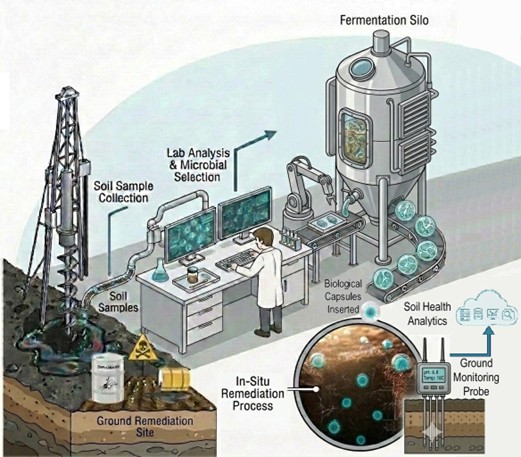
Soil endemic microorganisms and enzymes specifically tailored for pollutant removal will be selected. In addition, enhanced enzymes and reporter genes will be used to follow the bioremediation process. This includes the deployment of indigenous microbial consortia capable of degrading petroleum hydrocarbons, energetic compounds, and PFAS, isolated from contaminated sites and optimized for field use. In parallel, systems biology and metabolic modeling approaches will be applied to monitor and optimize microbiome behavior based on the specific genetic and environmental characteristics of each site.
Targeted stabilization systems:
Stabilization systems, such as encapsulation, that are being precisely tailored to both contaminant and soil type will be developed. These systems will ensure controlled release of the biological component, providing nutrient supply, and sustaining activity over time while adapting to changing nutrient and environmental conditions. The platform will incorporate advanced encapsulation and immobilization strategies, including polymer-based matrices, Pickering emulsions, foams, and colloidal carriers. These approaches are designed to improve durability under harsh subsurface conditions, enhance mass transfer between agents and contaminants, and enable effective transport across the vadose zone and into groundwater interfaces.
Advanced real-time monitoring:
Novel biological, electrochemical, and optical sensors will enable continuous tracking of the target contaminants. These systems will enable real-time monitoring of bioremediation across soil depths, identification of byproduct formation, detection of limiting degradation conditions, and dynamic adaptation of the treatment process. This capability is supported by a multi-modal sensing architecture integrating digital microfluidic systems (based on electrocapillarity) and microfluidic chips with on-chip thermal control for isothermal DNA amplification. Additional sensing modalities include optical systems (SERS/SERDS using silver-coated porous silicon microarrays), electrochemical sensors enhanced with carbon nanotubes and chemometric analysis, high-frequency QCM resonators functionalized with aptamers, and engineered biological sensors based on microbial reporters. These are complemented by autonomous field-deployable platforms incorporating photoluminescence excitation-emission measurements for extended spatial coverage.
Data integration & analytics:
All sensing modalities are fused within a unified analytical framework, enabling coherent, real-time assessment of contamination levels and bioremediation progress. Data is aggregated across spatial and temporal scales and analyzed using advanced models to support continuous optimization of treatment strategies and adaptive control of field operations.
While current market solutions often focus on isolated problems, Green Soil consortium adopts a holistic approach by synergistically integrating these three elements: biological components, stabilization, and monitoring. We aim to provide bioremediation solutions that respond to real-time field conditions, maximizing treatment efficiency, and delivering effective and sustainable bioremediation solutions across a wide range of soils and contaminants