Green Soil Working Process
Our work is structured into three main packages, each with specific objectives and collaborating partners. This ensures a comprehensive and integrated approach to soil bioremediation:
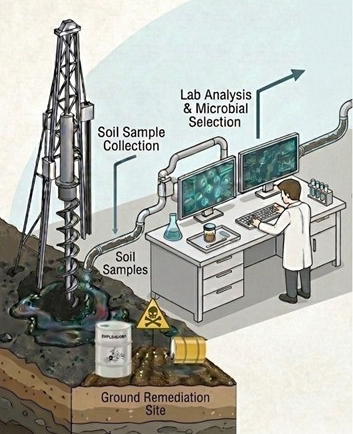
Work Group 1: The Biological Component
Focus:
Identifying, isolating, and developing effective endemic biological agents for contaminant degradation.
Key Activities:
- Contaminant Characterization: Developing methods for precise identification, quantification, and understanding of degradation kinetics and byproducts of various contaminants in laboratory settings, including toxicity assessments.
- Microorganism Development: Isolating and identifying native soil microorganisms. This will be done by leveraging advanced sequencing for microbiome characterization and developing metabolic models to optimize their activity. This includes the identification and isolation of environmental organisms with improved degradation capabilities for hydrocarbons, explosives, and PFAS.
- Genetic Enhancement (where applicable): Employing genetic engineering to improve the degradation efficiency and survival of biological agents, as well as optimizing enzyme expression.
- Initial Scale-Up: Conducting initial scale-up of fermentation processes (up to 5 liters) and developing preliminary fermentation protocols and soil bacteria formulations for target contaminants like explosives and fuels.
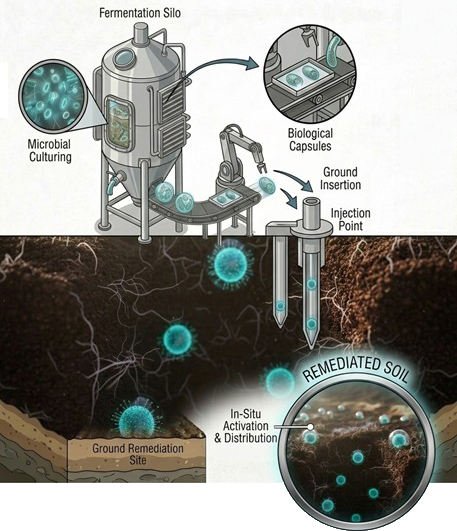
Work Group 2: Stabilization of the Biological Component for Effective Field Application
Focus:
Ensuring the viability, controlled release, and effective delivery of the isolated biological agents into contaminated soils.
Key Activities:
- Encapsulation and Stabilization: Developing advanced encapsulation and stabilization systems for the biological components, tailored to specific contaminants and soil types.
- Formulation Development: Creating optimized liquid or granular formulations designed to enhance the spread radius and viability of the biological component within the soil.
- Interaction Optimization: Developing formulations that promote better interaction between the biological component and the contaminants, as well as formulations that create a protective barrier layer against specific contaminants.
- Hybrid Substrates: Exploring and developing hybrid substrates that combine biological agents with other materials for improved performance and longevity.
- Formulation Testing: Evaluate formulation performance across diverse soil conditions, including soil sampling and contaminant removal studies using in house developed technology.
- Transport Systems: Developing and implementing efficient systems for delivering biological materials into the soil, potentially integrating them with existing irrigation infrastructure.
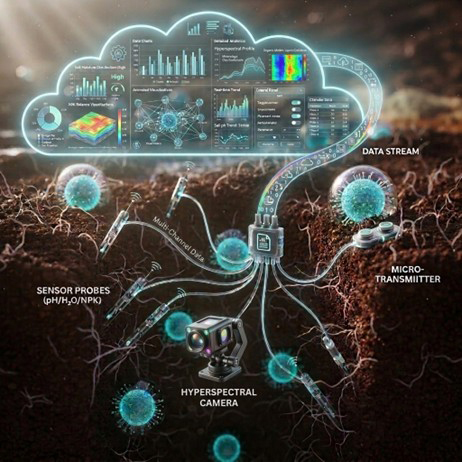
Work Group 3: System Monitoring and Application Efficiency in the Field
Focus:
Developing and integrating advanced real-time monitoring systems to track the bioremediation process and ensure treatment effectiveness.
Key Activities:
- Substance Transfer to Sensors: Creating capabilities for automated extraction and transfer of target substances (contaminants, byproducts, nutrients) from soil samples to sensors, utilizing microfluidics and pre-concentration methods.
- Field-Ready Sensors: Developing a range of highly sensitive, field-ready sensors including high-frequency microbalance sensors, optical sensors, electrochemical sensors, and genetically engineered biological sensors for quantitative detection of various parameters.
- Stand-Off Detection: Researching and developing stand-off detection capabilities, such as hyperspectral imaging and advanced optical systems, for remote quantitative analysis of contaminants, byproducts, and nutrients.
- Data Integration and AI: Integrating all sensor data, processing it with AI and computational systems, and presenting it intuitively through a cloud-based platform for comprehensive real-time monitoring and decision-making.